


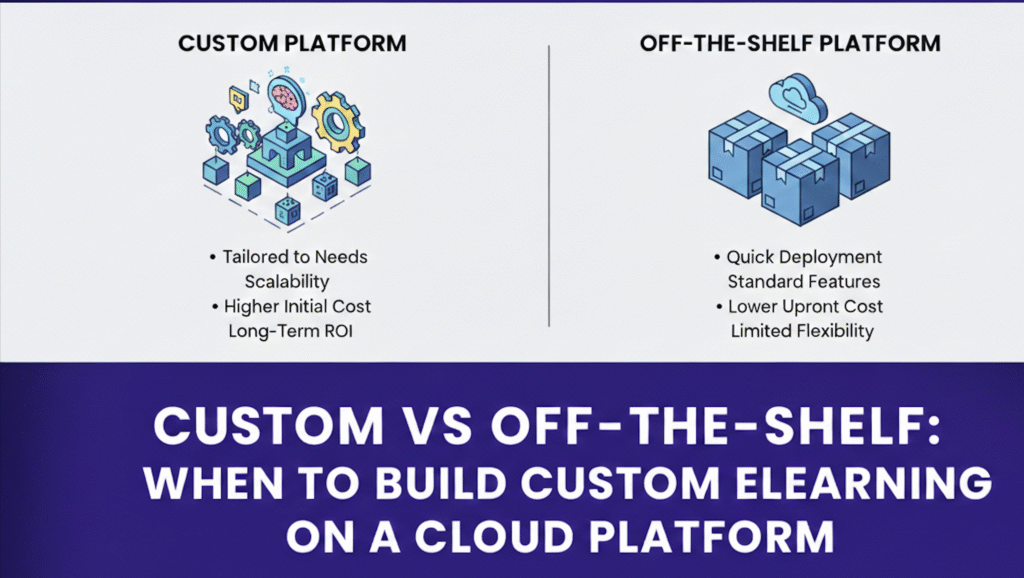
Quick Summary
- Organizations are increasingly choosing between ready-made eLearning content and custom-built learning solutions as cloud platforms accelerate digital training.
- Off-the-shelf training offers speed, lower upfront cost, and broad applicability, but lacks relevance for specialized workflows, compliance differences, and proprietary systems.
- Custom eLearning becomes essential when training must match organizational processes, job roles, customer enablement flows, or regulatory context (India + USA).
This guide helps you evaluate when to buy, when to build, and when a hybrid model makes the most strategic sense.
If you had to decide today whether to invest in custom eLearning or rely on off-the-shelf libraries, how confident would you be in that choice?
Many learning leaders across India and the U.S. are navigating this exact decision especially as cloud-based platforms make content creation faster, scalable, and easier to update. And while both models solve real business needs, the choice isn’t simply about cost; it’s about fit, longevity, relevance, and ROI.
Some organizations prioritize speed and coverage, while others require precision, simulation-based learning, or compliance specificity. The right approach depends on your strategy, not just your budget.
This guide breaks down both options clearly with real use cases, a comparison matrix, and a Build vs Buy decision framework to help you choose with confidence.
What You’ll Learn in This Guide
- Why is this decision increasingly important in 2026
- Where off-the-shelf content works and where it fails
- When custom eLearning becomes the smarter investment
- The role cloud platforms play in accelerating custom content
- Cost tiers, timelines, and ROI considerations
- A Build vs Buy decision matrix
- Subtle guidance on hybrid content strategies
- Practical next steps and a downloadable calculator
- FAQ based on real buyer concerns
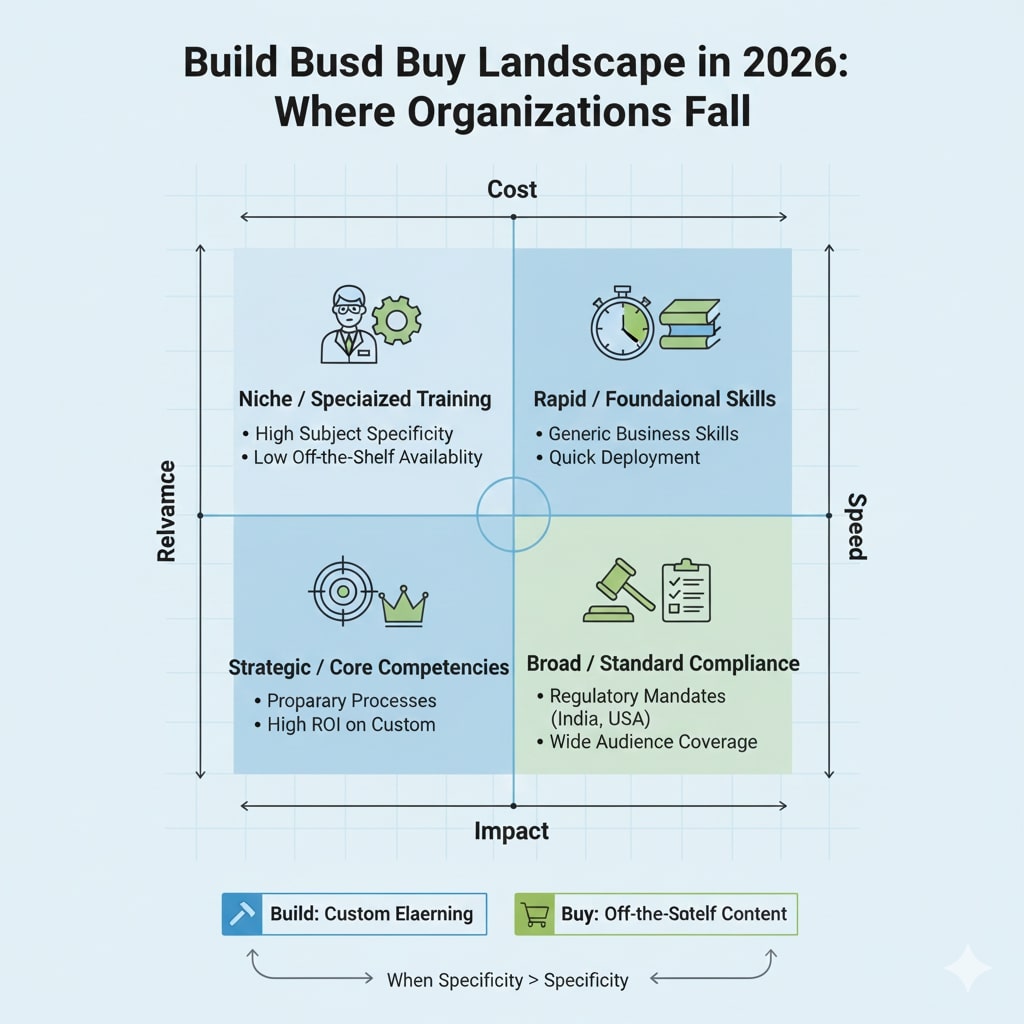
Before comparing custom and off-the-shelf directly, it’s important to understand why this decision matters more now than it did even two years ago.
Why This Decision Matters in 2026
If this question had been asked five or seven years ago, the answer would have been simpler: most organizations either bought off-the-shelf courses because they were fast and affordable, or they built custom content only when there was no alternative.
But learning expectations have changed.
Employees no longer want long, generic digital modules that feel disconnected from their work. Organizations don’t want training that checks a box; they want learning that improves performance, reduces errors, speeds onboarding, and supports real behavior change.
And with cloud platforms making content creation faster, more iterative, and more scalable, the conversation has shifted from:
“What content do we have available?”
to
“What content does our workforce actually need and what is the most efficient way to deliver it?”
The Shift in Enterprise Learning Priorities
Across India and the U.S., learning strategies are evolving due to:
- Hybrid and distributed workforces
- Rapid product releases and market cycles
- Increasing compliance requirements
- Skills-first talent models
- Customer and partner enablement demand
- Personalized role-based learning journeys
Learning can no longer be one-size-fits-all.
A 2025 LinkedIn Learning Report notes that 87% of organizations now prioritize role-specific learning experiences over generic skill libraries, especially in SaaS, BFSI, healthcare, and manufacturing environments.
Similarly, Deloitte found that organizations using tailored and context-driven content saw a 31– 49% improvement in measurable learning outcomes, compared to generic training approaches.
India vs USA Context: A Subtle but Important Difference
- India-based enterprises often begin with off-the-shelf content for scale and cost optimization before transitioning to hybrid or custom models as roles mature and compliance branches.
- US-based organizations more commonly adopt custom content earlier due to regulatory pressure, brand consistency expectations, and leadership enablement needs.
Both approach the same destination but from different starting points.
Why 2026 Makes This Decision More Strategic
Cloud-native authoring tools, faster iteration cycles, xAPI analytics, and modular learning architectures are changing what’s possible.
Training no longer needs to be:
- built once and forgotten
- generic
- static
- complex to update
- limited by format
Instead, organizations can now build living learning assets content that grows and adapts with the business.
And that’s what makes the build vs buy decision meaningful:
It’s not just about content, it’s about capability.
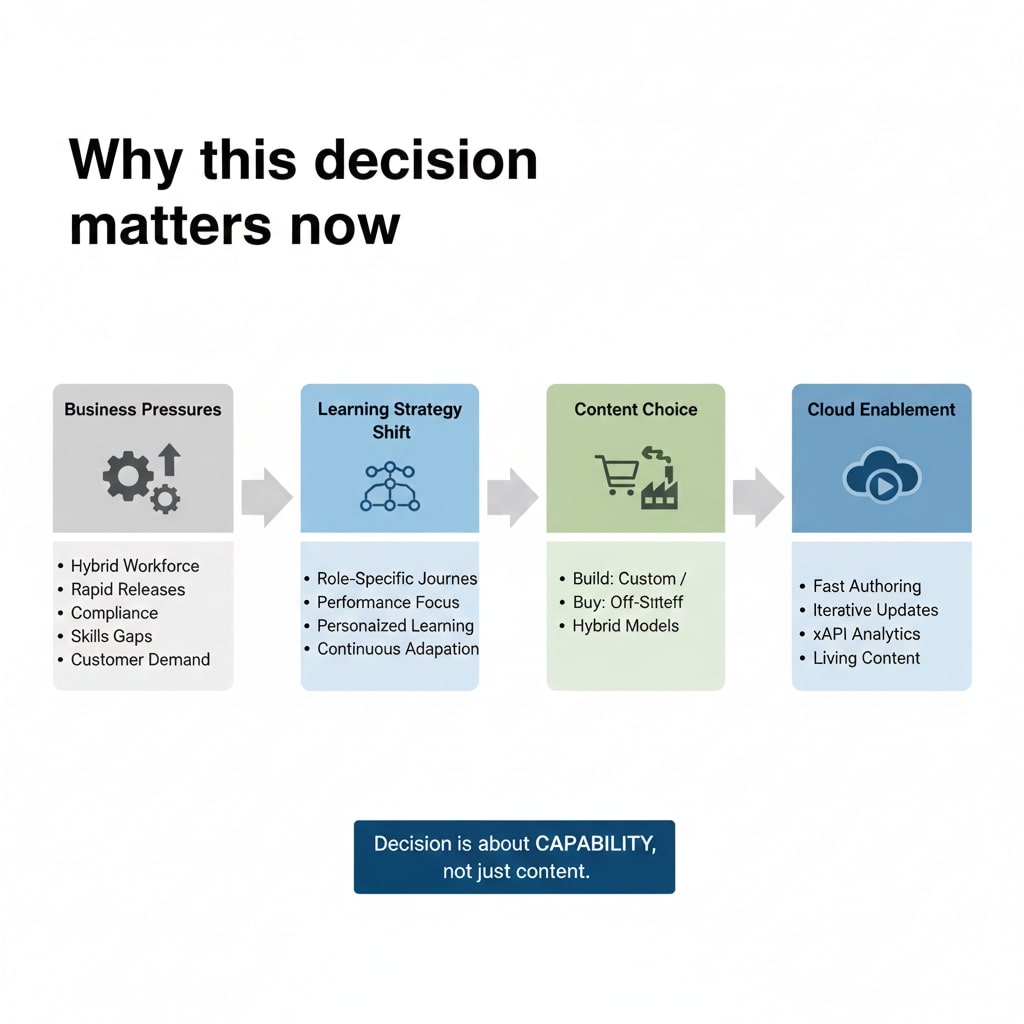
Now that the strategic importance is clear, let’s break down the first major option, off-the-shelf eLearning, and explore where it works well and where it falls short.
Off-the-Shelf eLearning: Strengths & Limitations
Off-the-shelf (OTS) eLearning has been one of the fastest ways for organizations to deploy training at scale, especially when speed and coverage matter more than customization. It’s accessible, predictable, and requires very little setup effort.
But while OTS content solves some real challenges, it isn’t a universal solution. In many cases, organizations later discover that initial convenience doesn’t always translate into long-term relevance or impact.
So instead of asking “Is off-the-shelf good or bad?”, a better question is:
“Where does it make sense and where does it fail to deliver the outcomes we need?”
Let’s break that down.
Benefits: Where Off-the-Shelf Works Well
Off-the-shelf content excels when training topics are universal, foundational, and not tied to internal systems or workflows.
Common use cases include:
- Compliance introductions (anti-harassment, cybersecurity basics)
- Soft skills (leadership, communication, teamwork)
- Safety awareness and general operational training
- Introductory onboarding foundations
- Industry awareness modules
For organizations needing to launch training quickly or cover large audiences at a low administrative burden, off-the-shelf content offers:
- Fast deployment (sometimes same-day access)
- Lower upfront investment
- No content development effort
- Stable update cycles handled by the vendor
- Broad catalog variety
This makes it ideal for companies scaling learning programs or starting their digital learning journey.
Where Off-the-Shelf Begins to Struggle
Off-the-shelf content often breaks down when training requires context, specificity, or organizational nuance.
Industries where this limitation becomes visible include:
- Cybersecurity + IT: Internal protocols, tools, and threat models differ widely.
- Manufacturing + Frontline Training: SOPs, equipment, and safety workflows vary by site.
- Healthcare: Compliance requirements (HIPAA, NABH, OSHA) need precision.
- BFSI/FinTech: Region-specific regulation (SEBI, PCI DSS, KYC, GDPR, FINRA) matters.
- SaaS + Technology: Product enablement must match actual software flows.
- Global workforce enablement: Localization requires meaning, not just translation.
When learning is generic, the learner experience becomes:
- disconnected from daily work,
- difficult to apply,
- and easy to forget.
A 2025 Training Industry Survey found that generic eLearning led to 2–3× lower course completion and engagement compared to customized pathways.
As learning strategies become more role-specific and data-driven, many teams discover that generic libraries can only go so far, especially when they’re trying to personalize at scale.
“Providing a personalized learning experience with off-the-shelf content is difficult (to say the least).”
– David Wentworth, Principal Analyst, Brandon Hall Group.
That’s exactly why organizations eventually start exploring custom, hybrid, or in-house content options, not because off-the-shelf is “bad,” but because it can’t always flex to match their culture, workflows, and systems.
Where Off-the-Shelf Fails Completely
OTS content does not work when:
- Training includes proprietary workflows or internal tools
- Compliance requires jurisdiction-specific documentation
- Skills must be validated through branching logic or simulations
- Customer-facing roles require brand voice consistency
- Learning must integrate with performance or product data
Another common issue:
Generic examples break immersion.
Learners feel disconnected when:
- The scenario doesn’t match their job reality
- The interface shown isn’t the tool they use
- The tone doesn’t reflect their organization or industry
And at scale, this becomes an adoption challenge, not just a content one.
Quick Snapshot: Off-the-Shelf Advantages vs Constraints
Strengths | Limitations |
Fast implementation | Limited relevance to internal workflows |
Lower initial investment | Engagement and retention often lower |
Vendor-managed updates | Cannot adapt to brand or strategy shifts |
Wide topic coverage | No control over depth, tone, or format |
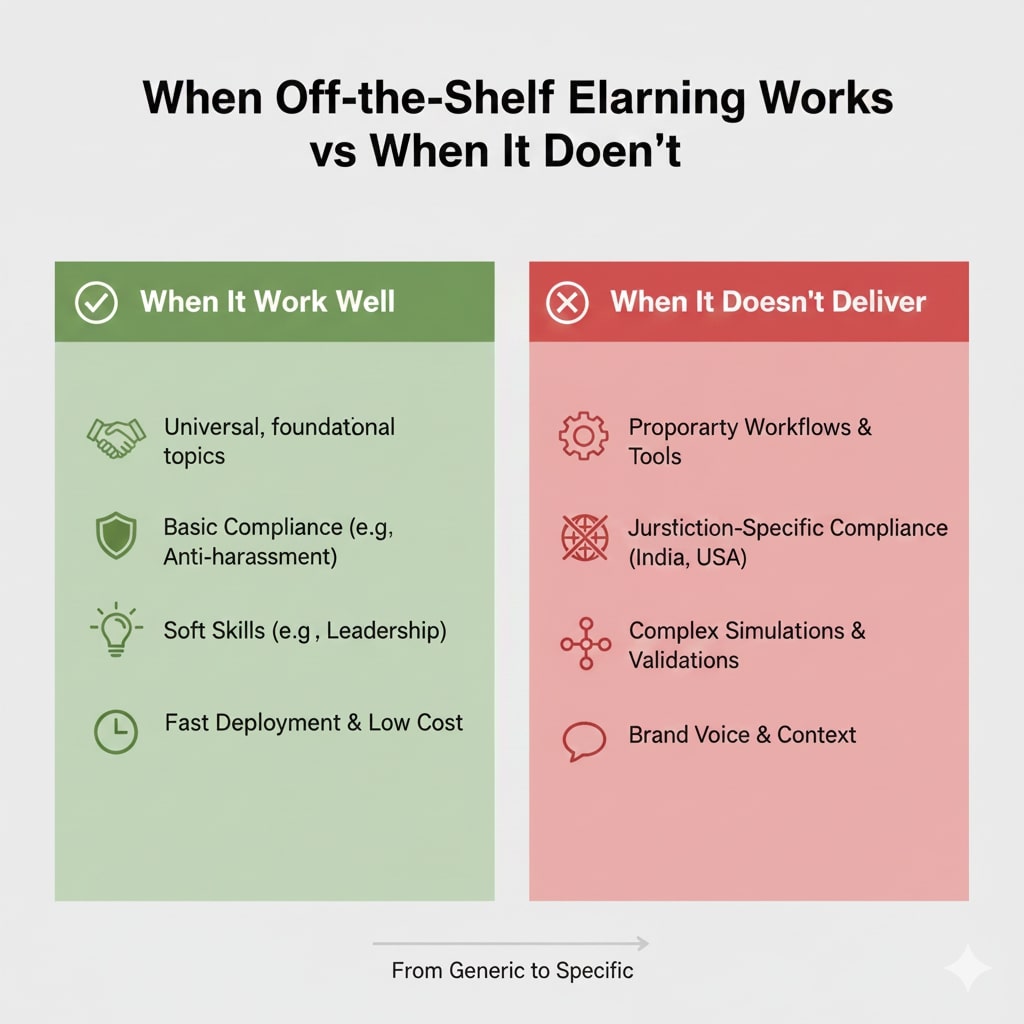
Off-the-shelf content has a clear place in certain learning strategies, especially at the foundational level.
But when training must reflect the way your organization works, sells, builds, or complies, generic content often falls short.
That’s when many teams start exploring custom eLearning.
When Custom eLearning Becomes Essential
If off-the-shelf learning solves general needs, custom eLearning exists to solve the specific ones, processes, decisions, compliance rules, tools, and workflows that make your organization unique.
Custom development isn’t always necessary, and it shouldn’t be positioned as the “better” option by default. Instead, the right question becomes:
“Is the learning experience we need unique enough that generic content cannot deliver the outcomes we expect?”
When the answer is yes, custom eLearning becomes the strategic choice.
When Training Involves Proprietary or High-Complexity Workflows
Some knowledge simply doesn’t exist in the market because it’s internal.
This includes:
- Product enablement and feature walkthroughs
- Engineering SOPs or manufacturing workflows
- Sales enablement journeys tied to actual product positioning
- Internal security protocols and escalation processes
- Customer support playbooks tied to product usage
In these cases, the training must map to exact systems, screens, terminology, and job tasks.
Anything generic risks confusion or worse, inconsistent execution.
A Deloitte learning trend report found that custom training aligned to real workflows increases performance outcomes by 40–65%, especially in technical and process-driven roles.
When Compliance or Localization Requirements Differ by Region
Regulated industries (BFSI, FinTech, healthcare, logistics, government, and manufacturing) often require content that reflects jurisdiction-specific requirements.
Differences between India and the USA alone can include:
Training Area | India | USA |
Data privacy | PDP Bill | CCPA / GDPR |
Healthcare | NABH standards | HIPAA / OSHA |
Finance | SEBI, RBI audits | FINRA, SEC compliance |
Workplace protection | POSH | Anti-harassment EEOC |
Generic compliance modules may introduce the concepts
But only custom content ensures accuracy and audit readiness.
When You Need Simulations, Scenarios, or Skills-Based Learning
Modern learning increasingly involves:
- Role-based scenarios
- Branching decision trees
- Software simulations (“practice before live”)
- Risk-based decision-making exercises
- Adaptive learning paths based on performance
These experiences can’t be bought pre-built because they must:
- Reflect the organization’s UI
- Use internal terminology
- Follow real escalation paths
- Align to real product limitations and customer expectations
This is where cloud-native learning unlocks the most flexibility, enabling iteration, analytics, and continuous improvement.
Real-World Buyer Pattern
Most organizations don’t move directly from generic → custom. Instead, they evolve:
- Foundational Phase: Off-the-shelf libraries for broad training
- Transitional Phase: Hybrid content for role-based workflows
- Strategic Phase: Custom learning ecosystems tied to business performance
This maturity journey mirrors observations from ATD and Training Industry analyses.
Expert Viewpoint
As Elliott Masie famously said:
“The biggest growth in e-learning will be in personalization.”
Custom learning enables personalization not just in design, but in relevance.
Quick Snapshot: When Custom Makes Sense
Condition | Custom Recommended? |
Specialized workflows | ✔✔ |
Product or brand training | ✔✔ |
Compliance varies by region | ✔✔ |
Rapid product updates | ✔✔ |
High-risk decisions or simulations | ✔✔ |
Broad corporate learning | Maybe |
Soft skills and leadership | Sometimes |
Basic compliance or awareness | X (OTS better) |
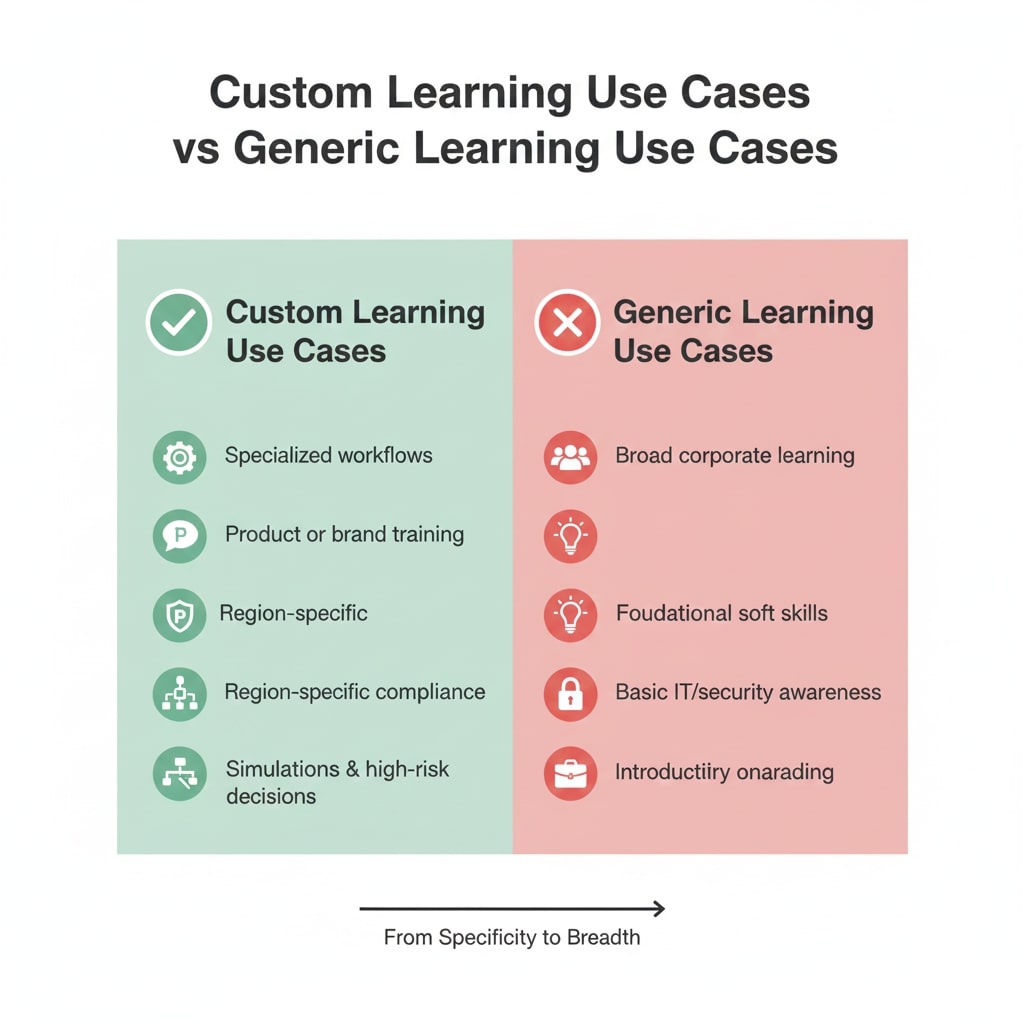
Custom eLearning can drive meaningful change, but the shift from development effort to learning value is significantly accelerated when content is built and delivered through modern cloud platforms.
That’s where the next section comes in.
Cloud Platforms as a Force Multiplier for Custom Content
Custom eLearning isn’t new; organizations have been building tailored courses for years. What has changed is how quickly and efficiently custom content can now be created, deployed, updated, and scaled thanks to modern cloud platforms.
In the past, custom content development was often seen as:
- slow,
- difficult to maintain,
- expensive to update,
- and dependent on external vendors.
Today, cloud-native learning ecosystems make custom content modular, reusable, measurable, and continuously improvable, not static.
Instead of thinking of learning as a one-time project, organizations are beginning to treat it as a living asset that evolves as the business evolves.
Faster Development & Iteration Through Modular Design
Cloud authoring tools and platforms enable teams to:
- Build reusable content blocks
- Update modules centrally without re-exporting SCORM files
- Localize content at the component level
- Create templates for repetition (onboarding, product updates, SOP changes)
This reduces effort and dramatically shortens iteration cycles.
A Training Industry analysis shows that cloud-native development environments reduce update cycles by 40–60% compared to legacy desktop tools, especially when integrating real-time feedback loops.
Scalable Delivery for Distributed Workforces
As organizations increasingly operate with hybrid or global teams, cloud platforms ensure content reaches learners wherever they are, without compromising performance.
Cloud infrastructure supports:
- Content Delivery Networks (CDNs) for faster global loading
- Offline-enabled mobile learning
- Multi-format learning (video, simulation, SCORM, xAPI, micro-learning)
- Version control for compliance-critical modules
This is especially valuable for sectors like manufacturing, hospitality, retail, and field operations where training isn’t always desk-based.
As Dr. Badrul H. Khan stated in his foundational work on web-based instruction:
“Web-based instruction provides learners with flexibility to access learning resources from anywhere and at any time.”
That vision aligns closely with how enterprises now expect learning to function.
Integration with Learning Ecosystems
Modern cloud platforms integrate seamlessly with:
- LMS / LXP platforms
- CRM and CX platforms for customer enablement
- HRIS systems for job-role mapping
- Analytics and BI pipelines
- SSO and enterprise authentication systems
These integrations enable:
- Personalized role-based content recommendations
- Automated enrollment workflows
- Performance-linked learning paths
- Real-time learning telemetry using xAPI
This makes learning not just consumable but trackable and adaptable.
A Deloitte Workplace Learning Study noted that organizations using integrated cloud learning ecosystems achieved 30–45% faster content iteration and insight-driven improvement.
Why Cloud Multiplies Value
Benefit Area | Legacy Model | Cloud-Native Model |
Content updates | Manual rebuilds | Centralized updates |
Scalability | Limited | Global delivery |
Personalization | Static | Adaptive, role-based |
Analytics | Course-level tracking | Experience-level telemetry |
Integration | Siloed | Ecosystem-connected |
So if off-the-shelf content is about reach and speed, and custom content is about relevance and impact, then cloud platforms help organizations achieve both efficiency and value.
Which brings us to the question most buyers care about next:
What does each approach mean in terms of cost, timeline, and ROI?
Cost, Timeline & ROI Comparison
Cost often becomes the most visible part of the conversation, but it shouldn’t be the only deciding factor. The smarter way to evaluate an investment is by balancing:
- Speed to launch
- Content lifespan
- Relevance to the job
- Impact on performance
- Future adaptability
Instead of “Which is cheaper?”, the real question is:
“Which option delivers better long-term value for what we’re trying to achieve?”
To make that decision easier, let’s break it down using high-level budget tiers (not exact pricing), timeline expectations, and ROI signals.
When you evaluate cost, it’s not just the budget line that matters — it’s the hours your learners spend inside those experiences. If the content doesn’t help them perform better, that time is effectively lost.
“There are no refunds; learners cannot get their time back if we waste it.”
– Michael Allen, e-learning expert
This is where custom eLearning often earns its investment: by making every minute of learning more relevant, more actionable, and more closely tied to real work.
Off-the-Shelf Cost Profile (Low → Medium)
Off-the-shelf learning content generally follows:
- Subscription or seat-based licensing
- Annual renewals
- Catalog-based access
Costs increase with:
- Audience size
- Additional modules
- Premium industry-specific tracks
- Localization requirements
Because content already exists, the timeline is immediate from same-day rollout to a few weeks for system-level alignment.
However, the ROI depends heavily on:
- Employee engagement
- Content applicability
- Alignment to business context
For foundational skills or widespread compliance coverage, this model offers excellent efficiency.
But when content is irrelevant or disconnected from real tasks, the ROI drops sharply even if the subscription cost appears low.
Custom eLearning Cost Profile (Medium → High)
Custom development is an investment model rather than a rental model.
Costs vary based on:
- Content complexity
- Format (SCORM, xAPI, simulation, animation)
- Number of modules
- Required integrations
- Localization and accessibility scope
Timeline expectations typically fall between a few weeks to several months, depending on:
- Project scope
- Stakeholder alignment
- Review and iteration cycles
The key value driver of custom content is performance improvement, not merely content access.
Organizations often see ROI through:
- Reduced time-to-competency
- Fewer onboarding mistakes
- Faster product adoption
- Better compliance accuracy
- Improved customer or partner enablement outcomes
Deloitte research suggests organizations using tailored, job-specific content see 30–55% efficiency improvements in training effectiveness compared to generic courseware.
ROI Comparison: What Actually Moves the Needle
A high-level decision lens looks like this:
Criteria | Off-the-Shelf (Buy) | Custom (Build) |
Upfront Cost | Lower | Higher |
Time to Deploy | Fast | Moderate |
Relevance | Generic | High |
Impact on Behavior | Moderate | High |
Ability to Update | Limited | Flexible (cloud-native) |
Long-Term Value | Variable | Strong when aligned to core workflows |
In other words:
- Off-the-shelf lowers effort.
- Custom increases impact.
Neither is better universally; each aligns to a distinct strategic purpose.
Quick Decision Signal
If your training changes frequently, is tied to internal workflows, or requires behavioral mastery, the ROI of custom content compounds over time.
If your training is baseline knowledge, broad, or universal, off-the-shelf may deliver the right balance of cost and accessibility.
Now that cost and ROI considerations are clearer, the next logical step is to apply a framework that helps you decide based on urgency, content type, audience needs, and business outcomes.
Decision Framework: Build vs Buy vs Hybrid
By now, you’ve seen that both off-the-shelf and custom eLearning have their strengths and their limitations. But most organizations don’t choose just one. Instead, they choose based on fit, urgency, audience needs, and strategic value.
So instead of asking: “Which approach is better?”
A more useful question is: “Which approach is right for this specific training need?”
This section gives you a simple, practical framework to make that decision confidently.
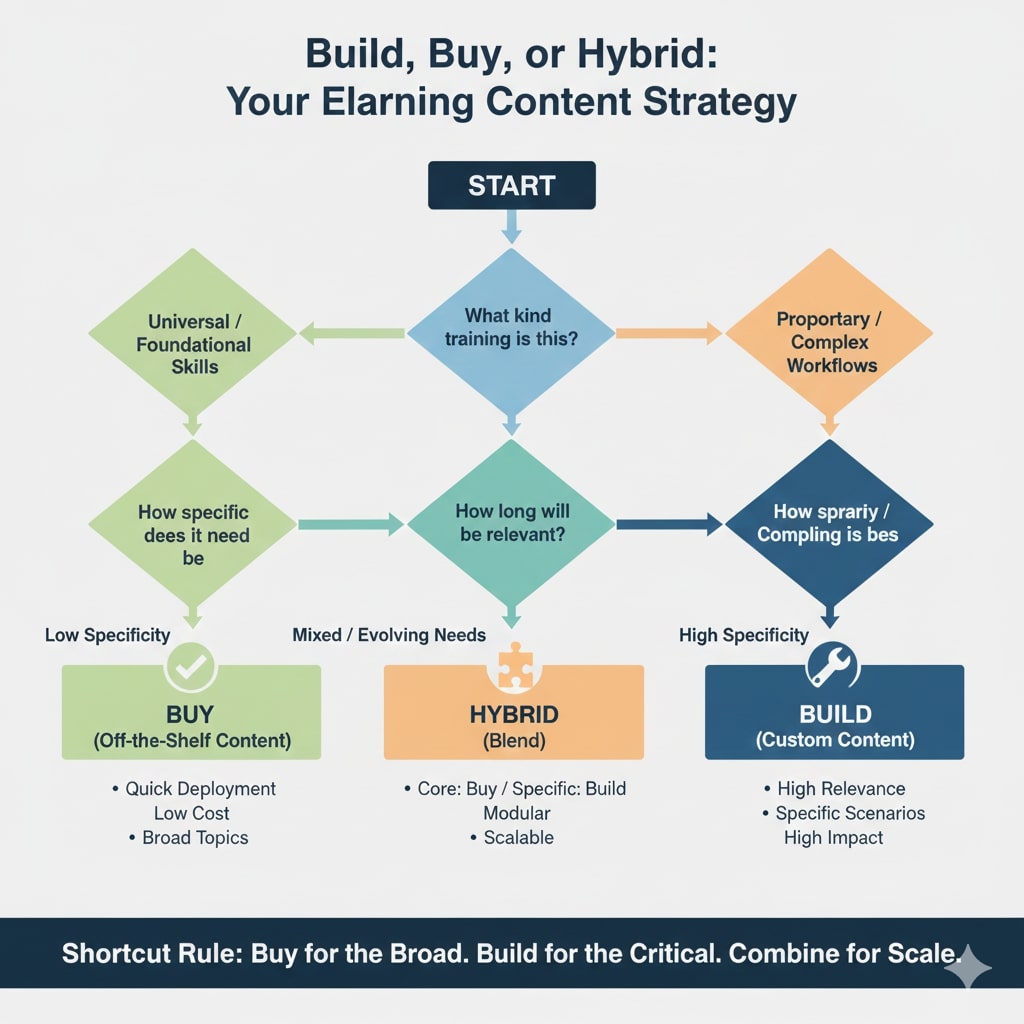
The Build vs Buy Matrix
Use the following matrix to evaluate where your training requirement fits:
Decision Factor | Buy (Off-the-Shelf) | Build (Custom) | Hybrid |
Urgency | Fast rollout required | Longer timeline | Can start with OTS, enhance later |
Relevance to internal workflows | Low | High | Moderate |
Content lifespan | Short-term or evergreen basics | Long-term or strategic | Mixed |
Compliance sensitivity | Low risk, universal laws | High risk, region-specific | Medium |
Role specialization | General roles | Technical or proprietary roles | Mixed |
Learner engagement required | Medium | High (simulations/scenarios) | High |
Budget flexibility | Lower initial cost | Medium–high investment | Controlled scaling |
If most of your checkmarks land in the Buy column → off-the-shelf is likely sufficient.
If a majority falls in the Build column → custom is the smarter investment.
If results are mixed → a hybrid strategy gives you the best outcome.
When Buying Makes the Most Sense
Choose off-the-shelf when:
- Training must be deployed immediately
- The topic is universal (ex, anti-harassment, communication, cybersecurity basics)
- The goal is coverage, not deep application
- Learners are early in their onboarding journey
A good example:
A global retail company onboarding 3,000 employees may use OTS for customer service basics, workplace safety, and soft skills because the content remains broadly consistent across roles.
When Building Is the Strategic Choice
Choose custom when:
- Training impacts performance, compliance, or customer experience
- Content needs to reflect internal tools, systems, processes, or branding
- The topic is proprietary or not available commercially
- The audience requires hands-on experience through scenarios or simulations
Example:
A SaaS company training its customer success team on a new AI-driven product release needs accuracy, UI alignment, and scenario-based guidance, none of which exists in generic catalogs.
When a Hybrid Model Is the Best Approach
Most mid-to-enterprise organizations end up here because it balances:
- Speed
- Relevance
- Cost
- Scalability
A hybrid approach typically looks like:
- Core skills, leadership modules, and awareness training: Off-the-Shelf
- Product enablement, compliance, workflows, simulations: Custom
- Microlearning updates and refresh cycles: Cloud-based modular content
This model grows with the organization and avoids the extremes of:
too generic or too resource-intensive.
It’s the most common path for India + USA enterprises scaling global learning ecosystems.
Shortcut Decision Rule
Buy for the broad. Built for critical. Combine for scale.
Once the decision framework is clear, the natural next step is understanding what execution looks like, especially for organizations leaning toward custom development.
And that’s where Nexority fits, not as an LMS vendor, but as a learning strategy, content development, and cloud engineering partner.
How Nexority Supports the Build Path
If your decision leans toward building custom eLearning, the next question usually becomes:
“Where do we start and who will build it?”
Not all organizations are equipped with the internal capabilities needed for curriculum mapping, instructional design, visual learning workflows, cloud-native authoring, or systems integration. And while many learning teams know what needs to be trained, they need help translating that knowledge into scalable, modern learning experiences.
That’s exactly where expert support becomes useful, not as a replacement for internal teams, but as an extension of them.
Nexority doesn’t sell LMS licenses or proprietary libraries. Instead, the focus is on helping organizations plan, design, build, and scale custom learning ecosystems that align with real workflows, systems, and goals.
Curriculum Design & Learning Strategy
Before a custom course ever becomes a storyboard or prototype, there’s a foundational step: aligning content with business needs and learner outcomes and this is where working with experienced curriculum design experts becomes critical.
This includes:
- Mapping job roles and competency frameworks
- Structuring learning paths for onboarding, enablement, or compliance
- Identifying what content already exists vs what needs to be created
- Defining delivery formats (microlearning, simulations, blended learning, ILT → VILT conversion)
The result is clarity, not just content.
Learners get what they need, not everything available.
Cloud-Native Content Development (SCORM, xAPI, HTML5, Simulations)
Once the strategy is aligned, development begins using cloud-first workflows that reduce friction and future-proof the content.
This phase is where strategy becomes execution and where custom eLearning development transforms internal knowledge into structured, scalable, cloud-ready learning assets.
Nexority supports:
- Simulation-based learning
- Branching logic scenarios
- Role-based modular microlearning
- SCORM/xAPI compliant modules
- Accessibility and localization
- Content modernization (Flash → HTML5, legacy → microlearning)
Because content is modular, updates don’t require costly rebuilds, making learning assets long-term instead of one-use.
Platform Engineering: Integrations, Microservices & Learning Apps
Modern learning ecosystems rarely operate in isolation which is why cloud learning platform engineering plays a critical role in ensuring content, systems, authentication, analytics, and delivery work together.
Custom content often interacts with:
- LMS or LXP platforms
- HRIS systems (Workday, BambooHR, SAP SuccessFactors)
- CRM or customer-facing academies
- BI analytics pipelines
- SSO and user provisioning environments
Nexority supports engineering the ecosystem so the content doesn’t just sit in a library, but becomes part of the learner’s workflow, identity, and performance environment.
A Quick Example
A SaaS company expanding into multiple international markets needed role-based enablement content for sales and customer success teams.
Their off-the-shelf content covered general onboarding and soft skills, but product mastery still required manual training.
After shifting to a custom cloud-native learning model, they reduced onboarding time by 28%, improved product certification pass rates, and standardized learning across teams in India, the U.S., and Europe.
Why This Matters
The goal isn’t just building custom modules, it’s creating a learning ecosystem that:
- Evolves with your product or organization
- Reduces friction between learning and work
- Supports scale, consistency, and performance impact
In other words:
Custom learning isn’t just content, it’s capability.
Now that the pathways are clear and you understand how support fits into the bigger picture, the final step is understanding what happens next and how to move forward confidently with your decision.
Next Steps
If you’ve made it this far, you likely already know this decision isn’t binary.
It isn’t simply:
“Custom or off-the-shelf?”
Instead, it becomes:
“What does the organization need today and what will it need as it grows?”
For some teams, the right next step is piloting with off-the-shelf content.
For others, the opportunity cost of generic training is already clear, and the shift to custom content is overdue.
And for many organizations, particularly those scaling across India, the U.S., or globally distributed teams, a hybrid learning ecosystem ends up being the most strategic path.
The best way forward is understanding:
- Which training needs fall into “Buy.”
- Which require “Build.”
- And where a hybrid approach creates the best balance of value, relevance, and scalability
To make that easier, we’ve created a simple tool to help you assess the right direction based on urgency, content type, audience, and long-term business alignment.
Try the Build vs Buy Decision Calculator
This tool helps you:
- Score training requirements objectively
- Compare urgency vs customization needs
- Identify which modules belong in each category
- Align stakeholders around a clear decision
Most teams use it during planning, budgeting, or learning modernization discussions.
Need help evaluating your learning ecosystem?
If you’d like support turning the results of the calculator into a clear roadmap or you’re still unsure where your training needs fit, our team can help walk through your requirements and share options.
No sales pressure. Just clarity.
If you’d like support reviewing your training ecosystem or applying the decision calculator to your environment, you can schedule a learning strategy consultation with our team.
Before closing, let’s address a few common questions learning leaders ask when considering the shift from generic training to custom content.
Frequently Asked Questions
These are some of the most common questions learning leaders ask when deciding between off-the-shelf content and custom eLearning development.
1. When does off-the-shelf eLearning NOT work well?
Off-the-shelf falls short when training requires specific workflows, product knowledge, organization context, compliance differences, or simulations.
If the content must map closely to internal tools, systems, or real scenarios, generic modules create confusion, not clarity.
2. How expensive is custom content really?
Custom eLearning sits in the medium-to-high budget tier, depending on factors like complexity, format (video, simulations, branching logic), and localization.
Unlike subscriptions, custom content behaves as a long-term asset, especially when developed using cloud-native modular workflows.
3. Can we combine custom and off-the-shelf content?
Yes, and in most cases, this leads to the best outcome.
Organizations often purchase off-the-shelf content for broad topics (soft skills, foundational compliance, leadership) and invest in custom learning for role-based, proprietary, or business-critical content.
This hybrid model also helps teams scale strategically.
4. What internal involvement is required for custom development?
Teams typically contribute:
- Subject matter expertise
- Brand and product context
- Compliance or regulatory requirements
- Stakeholder approvals
A good development partner handles strategy, instructional design, authoring, testing, accessibility, and engineering while ensuring your SMEs aren’t overloaded.
5. How long does custom eLearning development take?
Timelines vary based on scope, depth, and complexity but typically range from a few weeks for simple modules to multiple months for simulations, multi-role journeys, or enterprise programs.
With cloud workflows, update cycles become significantly faster over time.