


Ed-Tech
Cloud-Based eLearning Software
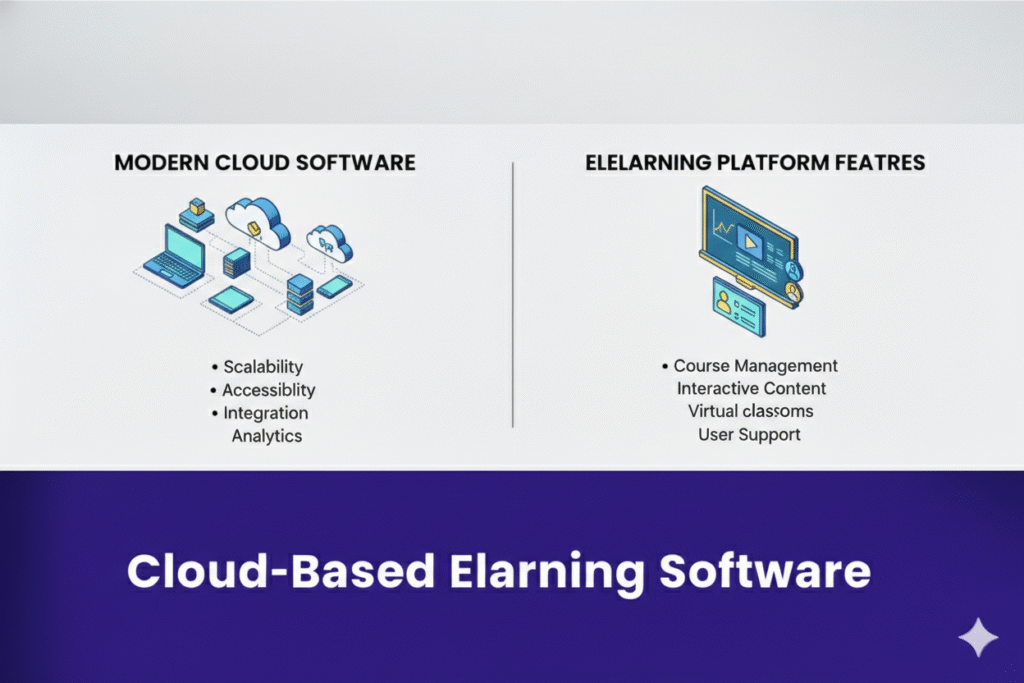
Quick Summary:
- Cloud-based eLearning software is no longer just an LMS hosted online; it’s the core learning infrastructure for modern enterprises
- Most organizations underperform because they treat cloud learning as a tool decision, not a system decision
- The real value comes from how delivery, content, analytics, security, accessibility, and measurement work together
- This page exists to help you evaluate cloud eLearning strategically, not tactically
- If you’re modernizing, scaling, or rethinking enterprise learning, this page gives you the right mental model before you choose platforms or partners
If our learning platform is already “cloud-based,” why does training still feel slow, fragmented, and hard to measure?
You’ve likely seen this play out.
Your organization has:
- Migrated off on-prem systems
- Rolled out browser-based learning
- Enabled remote or hybrid access
- Invested in new tools and content
And yet, learning still struggles to keep up with the business.
Programs take too long to launch.
Analytics feel shallow or disconnected.
Updates require workarounds.
Impact is hard to prove outside of completion rates.
That disconnect isn’t accidental. It happens when cloud-based eLearning is treated as a purchase decision, instead of what it actually is: a business system that supports scale, speed, governance, and insight.
Cloud-Based eLearning Has Quietly Become Core Infrastructure
Across enterprises, learning has shifted roles.
It’s no longer just about:
- Hosting courses
- Tracking completions
- Supporting compliance
Today, learning systems are expected to:
- Scale across regions and roles
- Support continuous upskilling
- Integrate with HR, performance, and data systems
- Adapt quickly as business priorities change
- Provide visibility into behavior, not just attendance
This is why so many organizations feel friction even after “moving to the cloud.”
They adopted cloud delivery, but not a cloud learning architecture.
As industry practitioner Jocelyn Brown, Head of Customer Success at Hypercontext, notes:
“Value realization is defined by the customer, and it is not static.”
Jocelyn Brown, Head of Customer Success, Hypercontext
That insight applies directly to enterprise learning.
If your learning systems can’t evolve with how people work, learn, and perform, they stop delivering value regardless of where they’re hosted.
What This Page Is Designed to Help You Do (Without Reading Like a Manual)
Rather than listing tools or ranking platforms, this page is meant to give you clarity before choice.
As you read through it, you’ll see how:
- Cloud-based eLearning software should be understood in business terms, not technical jargon
- Cloud delivery, scalability, and security work at a high level without architecture overload
- Legacy and on-prem LMS models create friction as organizations scale
- Modern cloud learning supports outcomes like agility, insight, and faster time-to-value not just cost savings
- Platforms, custom development, authoring tools, accessibility, analytics, and ROI measurement fit together as one system, not isolated decisions
Each section stays intentionally high-level, then points you to deeper resources when a topic deserves focus.
How to Use This Page (Practically)
If you’re:
- Exploring cloud-based eLearning for the first time
- Replacing or modernizing a legacy LMS
- Scaling learning across teams, regions, or partners
- Trying to connect learning data to real business outcomes
You can read this page end-to-end for context or jump to the sections that match where you are right now.
Either way, the goal stays the same:
To help you think about cloud-based eLearning software as a system, not a tool.
From here, we’ll move into a clear, business-first definition of what cloud-based eLearning software actually is before getting into how it works, how it compares to legacy models, and how enterprises should evaluate it.
What Is Cloud-Based eLearning Software?
Cloud-based eLearning software is often described simply as “an LMS hosted online.”
That definition is technically correct but strategically incomplete.
For enterprise organizations, cloud-based eLearning software is not just a training platform.
It functions as a learning delivery infrastructure that supports scale, speed, governance, and insight across the business.
When you evaluate cloud learning properly, you are not choosing a tool.
You are defining how learning operates as a system inside your organization.
Before diving into the business definition, it helps to see the big picture. This video provides a beginner-friendly walkthrough of why businesses rely on these platforms and how they support scale and compliance.
Definition in Business Terms
At an enterprise level, cloud-based eLearning software is:
- A browser-accessible learning environment
• Delivered through cloud infrastructure instead of on-prem servers
• Managed through centralized administration
• Continuously updated without internal IT deployments
• Designed to support distributed, remote, and growing workforces
But the defining shift is this:
It moves learning from a location-bound system to a scalable operational capability. Instead of asking, “Where is the software hosted?”
You begin asking, “How does learning scale, adapt, and connect to the business?”
That’s a fundamentally different decision.
Core Components of Cloud-Based eLearning Software
Cloud-based learning systems work because several layers operate together:
Platform Layer
This is the user-facing system where learners:
- Access courses
• Complete learning activities
• Track progress
• Interact with content
It also provides admin control for:
- Enrollment
• Permissions
• Reporting
Content Delivery Layer
This is how learning experiences are distributed and consumed:
- Browser-based playback
• Mobile compatibility
• Media hosting
• Content version control
This layer ensures learning can be accessed anywhere without local installation.
Cloud Infrastructure Layer
This is the underlying environment that supports reliability and scale:
- Remote hosting (instead of internal servers)
• Elastic scalability during usage spikes
• Global accessibility
• Automatic system updates
Enterprises typically rely on secure, enterprise-grade providers such as Amazon Web Services or Microsoft Azure for this foundation.
Analytics & Reporting Layer
Modern cloud learning systems collect behavioral and performance data that allows you to:
- Track engagement trends
• Monitor usage patterns
• Identify skill gaps
• Connect learning data to workforce outcomes
This layer is what transforms learning from content delivery into a decision-support infrastructure.
Why Organizations Are Moving Away from Legacy LMS
The shift to cloud-based eLearning is not just technological.
It’s operational.
Traditional LMS environments often create friction because they were designed for:
- Centralized office environments
• Static training programs
• IT-controlled update cycles
• Compliance tracking over performance insight
Cloud-based learning software addresses these constraints by enabling:
- Faster rollout of programs
• Easier updates and content iteration
• Remote and hybrid workforce support
• Continuous system evolution instead of version upgrades
The result is not just modernization, it’s the ability for learning to move at the speed of the business. Cloud-based eLearning software, when understood correctly, is less about “moving training online” and more about building a scalable learning architecture that can evolve as your organization grows.
How Cloud-Based eLearning Software Works
Understanding cloud-based eLearning software isn’t about technical diagrams. It’s about understanding how learning delivery becomes scalable, reliable, and continuously evolving without the operational bottlenecks of legacy systems.
At a high level, cloud learning works through a delivery model, architecture structure, and security framework that operate together behind the scenes so learning teams can focus on programs instead of infrastructure.
Cloud Delivery Model (SaaS Explained Simply)
Cloud-based eLearning software is delivered using a Software-as-a-Service (SaaS) model.
That means:
- Learners access the system through a web browser
• No software installation is required on user devices
• No internal hosting infrastructure is needed
• Updates happen automatically in the background
• Access works across locations, devices, and time zones
For your organization, this removes traditional friction such as:
- Server maintenance
• Version upgrade projects
• IT dependency for every system change
Instead of managing infrastructure, your team manages learning strategy and experience. This is why cloud learning environments adapt faster to business changes, new programs, new audiences, and new compliance needs without rebuilding the system each time.
Architecture Overview
Behind the interface, cloud-based eLearning systems rely on a distributed architecture designed for scale and reliability.
Key characteristics include:
- Remote hosting in secure cloud environments
• Elastic scalability system performance adjusts automatically during usage spikes
• High uptime to ensure global availability
• Load balancing to prevent slowdowns during peak learning periods
This architecture allows thousands or even hundreds of thousands of learners to access training simultaneously without degrading performance.
Enterprise learning platforms commonly rely on infrastructure from providers such as Amazon Web Services (AWS) or Microsoft Azure, which offer:
- Global data center networks
• Built-in redundancy
• Enterprise-grade reliability
For learning teams, this means fewer system disruptions and more predictable delivery.
Security & Data Handling Basics
Security in cloud-based eLearning environments is built into the system architecture rather than added as an afterthought.
Core practices typically include:
- User authentication controls (secure login, identity verification)
• Role-based access permissions to control who can view or manage content
• Encrypted data transmission during usage
• Secure content hosting to protect learning materials
• Protected reporting pipelines for learner data
Because learning data often connects to HR, performance, and compliance systems, secure data handling is critical.
Cloud platforms simplify this by maintaining consistent security standards across regions, something that is much harder to sustain in decentralized, on-prem environments.
What This Means Operationally
When cloud-based eLearning software works properly, several invisible processes become effortless:
- Programs can be launched globally without infrastructure planning
• Content updates go live instantly across audiences
• System performance scales automatically
• Learning data becomes continuously available for reporting
• IT involvement shifts from daily support to governance oversight
The technical complexity is absorbed by the cloud architecture, allowing your organization to focus on:
- Learning design
- Program effectiveness
- Skill development
- Business outcomes
That’s the operational shift: learning stops being constrained by technology and starts being enabled by it.
How Cloud-Based eLearning Software Works
At a glance, cloud-based eLearning software may seem simple: learners log in through a browser and access training. But what actually makes cloud learning powerful and scalable is how the system works behind the scenes.
When you understand this, you stop seeing it as “software” and start recognizing it as operational infrastructure for learning.
Let’s break it down clearly.
Cloud Delivery Model (SaaS Explained Simply)
If you’ve ever accessed a learning platform through a browser without installing anything, you’ve already used the cloud delivery model.
Here’s what that really means for you:
- The platform runs on remote cloud servers, not inside your organization
• Learners access it through the web anywhere, anytime
• Your IT team doesn’t maintain hardware or install upgrades
• System updates happen automatically in the background
So instead of managing learning technology, your teams focus on managing learning outcomes.
That’s the quiet shift SaaS enables: less infrastructure work, more operational agility.
Architecture Overview (What Supports Scale)
Behind the interface your learners see is an architecture designed to handle growth and complexity.
This is where cloud learning differs from traditional systems.
You benefit from:
- Elastic scalability: the system adjusts automatically as usage increases
• High uptime reliability: learning stays available globally
• Performance optimization: faster load times across regions
• Continuous improvements: no “big version upgrades.”
In practical terms, this means your learning programs don’t slow down when your organization scales. The system is designed to grow with you, not hold you back.
Security & Data Handling Basics
Security often feels like a technical topic, but for enterprise learning, it’s operational risk management.
Modern cloud-based learning systems typically include:
- Secure user authentication
• Role-based access controls
• Data encryption during transfer and storage
• Centralized content governance
These safeguards help ensure:
- The right people see the right content
• Sensitive information stays protected
• Learning data remains trustworthy for reporting
Under the hood, many enterprise learning platforms rely on large-scale cloud infrastructure providers such as Amazon Web Services or Microsoft Azure. You don’t need to manage that infrastructure directly, but it’s what enables enterprise-grade reliability and security.
Analytics & Reporting Flow
One of the biggest shifts cloud architecture enables is data visibility. Because learning happens inside a connected environment, the system can capture:
- Engagement patterns
• Usage trends
• Skill development signals
• Completion and performance data
This information flows into reporting systems that help you move from tracking activity to understanding impact. When this layer works well, learning stops being a compliance tracker and becomes a source of operational insight.
Why This Structure Matters
So while cloud-based eLearning software may look like a platform on the surface, what you’re really working with is a multi-layer system:
delivery + infrastructure + security + analytics.
And when those layers operate together smoothly, learning can scale, adapt, and support business decisions without constant technical intervention.
That’s the difference between hosting courses in the cloud and building a cloud learning architecture.
Business Benefits of Cloud-Based eLearning Software
Once cloud-based eLearning is understood as infrastructure, not just a platform, the conversation shifts from features to outcomes.
This is where many enterprise learning decisions become clearer.
You’re not asking,
“What can this system do?”
You’re asking,
“What becomes easier, faster, safer, or more measurable because this system exists?”
Cloud-based eLearning software changes how learning operates across scale, risk, data, and speed, the same dimensions leadership already uses to evaluate core business systems.
Scalability Across Teams, Regions & Growth
As your organization grows, learning demand doesn’t increase in a straight line. It multiplies.
New regions, new roles, new compliance needs, new product training, new onboarding cycles, all happening at once.
Traditional learning systems struggle here because they were designed around fixed capacity and centralized environments.
Cloud-based eLearning changes that equation.
You can:
- Roll out learning globally without new infrastructure
• Support thousands of concurrent learners during launches
• Expand programs without IT deployment cycles
• Maintain consistency across regions while adapting locally
This is what real scalability looks like, not just more users, but learning that expands at the same speed as the business.
When learning can scale without friction, growth stops creating training bottlenecks.
Security, Compliance & Risk Reduction
Enterprise learning environments handle sensitive data:
- Employee information
• Certification records
• Regulatory training documentation
• Audit trails
In on-prem systems, maintaining security often depends on internal IT resources, manual updates, and patch management.
Cloud-based environments shift much of this burden into structured, continuously maintained infrastructure.
That means:
- Regular security updates without disruption
• Controlled user access and permissions
• Centralized compliance tracking
• More reliable audit documentation
Instead of security being a reactive process, it becomes part of the operating model.
For regulated industries or global organizations, this reduces operational risk and strengthens governance without slowing down learning delivery.
Learning Analytics That Drive Business Decisions
Completion rates tell you who finished a course. They don’t tell you what changed. Modern cloud-based eLearning software supports behavioral and performance data that gives you deeper visibility into learning impact.
You can begin to see:
- Engagement trends across roles or regions
• Usage patterns over time
• Skill development signals
• Areas where learners struggle or disengage
When learning data becomes part of business insight, not just reporting, L&D shifts from a support function to a strategic contributor.
Leaders can ask:
Are our people developing the capabilities we need?
Where are gaps emerging?
Which programs actually influence performance?
Those are business questions, not training questions.
Faster Time-to-Value & Lower IT Overhead
In legacy environments, every update can become a project:
- New versions
- System maintenance
- Infrastructure upgrades
- Integration work
Cloud-based learning reduces this cycle.
You can:
- Launch programs faster
• Update content without system downtime
• Add new capabilities without large deployment efforts
• Shift IT from maintenance to strategy
The result isn’t just efficiency, it’s agility.
Learning can respond to:
- New business initiatives
• Product launches
• Policy changes
• Workforce shifts
Without waiting for infrastructure to catch up. That responsiveness is what allows learning to operate at business speed.
Cloud-based eLearning software, when evaluated through these lenses, stops being a technology upgrade and becomes an operational advantage.
It helps learning:
- Scale with growth
- Stay secure under pressure
- Produce usable insight
- Move as fast as the business itself
That’s the real benefit and the reason cloud learning has become foundational, not optional.
Industry Use Cases for Cloud-Based eLearning
Once cloud-based eLearning software is understood as infrastructure, its value becomes easier to see across different environments.
What changes from industry to industry is not the system but how that system supports different types of risk, scale, and workforce needs. Cloud learning works because it adapts to context without requiring a different platform each time.
Enterprise Corporate Training
Large enterprises face constant learning demand:
- Onboarding across roles and regions
• Leadership development
• Product and process training
• Internal mobility and reskilling
These environments require:
- Consistency at scale
• Role-based learning paths
• Integration with HR and performance systems
Cloud-based eLearning supports this by allowing centralized governance with local flexibility. Programs can be standardized globally while still adjusting for language, compliance, or regional differences.
Most importantly, learning doesn’t slow down as the organization grows it becomes part of the operational rhythm.
Healthcare & Compliance-Driven Training
Healthcare and regulated industries operate under strict requirements.
Training must be:
- Documented
• Repeatable
• Traceable
• Auditable
At the same time, workforces are often distributed across sites, facilities, or remote environments.
Cloud learning systems make it easier to:
- Track certifications and renewals
• Maintain up-to-date training across locations
• Provide role-specific compliance programs
• Generate audit-ready records
The system becomes part of risk management, not just education.
Manufacturing & Safety Enablement
Manufacturing environments often combine:
- Shift-based workforces
• Operational risk
• Equipment and process training
• Safety requirements
Training must be accessible, reliable, and consistent, even when schedules and locations vary.
Cloud-based eLearning allows:
- Mobile-accessible safety training
• Standardized processes across sites
• Rapid updates when procedures change
• Scalable onboarding for new hires
Learning here directly influences operational safety and productivity.
SaaS Customer & Partner Education
For SaaS companies, learning extends beyond employees.
Customers and partners need:
- Product onboarding
• Feature education
• Certification programs
• Ongoing updates
Cloud-based learning enables:
- Global access without installation
• Self-paced learning at scale
• Consistent product education across regions
• Insight into where users struggle or disengage
This turns learning into part of the customer experience, not a separate function.
Government & Regulated Industries
Public sector and regulated environments balance:
- Security
• Compliance
• Large, distributed populations
• Structured governance
Cloud-based learning helps organizations:
- Maintain centralized oversight
• Deliver training consistently across agencies or departments
• Support accessibility requirements
• Document compliance activity
In these contexts, learning systems must be reliable, secure, and structured cloud infrastructure supports that stability while still allowing growth.
Across industries, the pattern is consistent. Cloud-based eLearning software does not replace domain expertise. It provides a stable foundation that allows learning to operate under different constraints without redesigning the system each time. The platform stays the same. The application adapts. That’s what makes cloud learning infrastructure not just software.
Key Cloud-Based eLearning Topics Explained
Before you move deeper into platform comparisons, vendor evaluations, or architecture decisions, it helps to understand how the different parts of a cloud learning ecosystem connect.
This section is intentionally high-level.
Each topic below introduces an important capability area and points you to a focused resource where the subject is explored in depth.
Think of this as the map, not the deep dive.
What Is Cloud-Based eLearning Software?
At its core, cloud-based eLearning software provides a browser-accessible environment where learning can be delivered, managed, updated, and measured without local hosting.
But at an enterprise level, its importance goes beyond access. It defines how learning scales, how updates are handled, how data is captured, and how governance is maintained across distributed teams.
Understanding this foundation is critical before evaluating platforms or vendors. Without that clarity, decisions often default to feature checklists instead of operational fit.
If you want a deeper breakdown of what cloud-based eLearning software actually means beyond high-level definitions, you can explore the full guide to cloud-based eLearning software.
Top Cloud-Based LMS Platforms in 2026
Not all cloud learning platforms are built with the same priorities.
Some emphasize content management, others analytics depth, others ecosystem integrations. For enterprises, platform choice affects long-term scalability, reporting flexibility, security posture, and how easily learning can evolve with business needs.
Evaluating platforms requires looking beyond feature lists and focusing on how well a system supports growth, integration, and continuous improvement.
Platform selection is one of the most strategic decisions, which is why we’ve put together a comparison of the top cloud-based LMS platforms in 2026 based on enterprise evaluation criteria.
Custom vs Off-the-Shelf Cloud eLearning
Organizations often face a critical decision: adapt internal processes to a platform, or shape the learning experience more precisely through custom development.
Off-the-shelf platforms offer speed and structure. Custom solutions offer flexibility, brand alignment, and deeper integration potential. The right choice depends on scale, complexity, internal capability, and long-term learning strategy.
This is not a technical decision alone it’s an operating model decision.
Platform selection is one of the most strategic decisions, which is why we’ve put together a comparison of the top cloud-based LMS platforms in 2026 based on enterprise evaluation criteria.
Best Cloud Authoring Tools for Collaboration
Authoring tools are often treated as separate from platforms, but they are a core part of the cloud learning ecosystem.
They determine how quickly content can be created, updated, and localized and how easily subject-matter experts can collaborate with learning teams.
In cloud environments, collaborative authoring supports faster iteration and keeps learning aligned with changing business needs.
If you’re weighing whether to build tailored learning experiences or use packaged solutions, the custom vs off-the-shelf cloud eLearning decision framework walks through when each approach makes sense.
Accessibility-First Cloud eLearning Design
Accessibility is not just a compliance requirement it affects usability, engagement, and learning effectiveness for everyone.
Cloud-based environments make it easier to apply accessibility standards consistently across content, devices, and regions. Designing with accessibility in mind reduces barriers, supports inclusion, and lowers long-term rework.
It becomes part of quality, not an afterthought.
Authoring tools are a core part of the ecosystem, and you can review the best cloud authoring tools for team collaboration to understand how content creation fits into the system.
How Much Does Custom Cloud eLearning Cost?
Costs in cloud eLearning are shaped by more than platform licensing.
Content design, interactivity, accessibility, integrations, analytics requirements, and governance workflows all influence investment levels. Understanding these cost drivers helps organizations plan realistically and align spend with outcomes.
Cloud learning ROI should be evaluated in terms of speed, scalability, and performance impact not just production expense.
Accessibility is both a compliance requirement and an engagement strategy, which is why we’ve outlined an accessibility-first course design guide for cloud eLearningaligned with WCAG and Section 508.
Measuring Learner Impact from Cloud eLearning
Modern cloud learning systems generate far more data than traditional LMS reporting ever allowed.
But measurement only becomes valuable when data connects to performance, behavior, and business outcomes. Tracking completions alone no longer reflects learning effectiveness.
Understanding how to interpret and act on learning analytics is key to turning cloud eLearning into a decision-support system.
Budget expectations vary widely, so we’ve detailed the key cost drivers of custom cloud-based eLearning development to help you plan realistically.
Together, these topics show that cloud-based eLearning is not a single decision it’s an ecosystem of interconnected choices.
Platforms, content, tools, accessibility, analytics, and cost structure all shape how learning performs inside the enterprise.
How to Choose the Right Cloud-Based eLearning Software
By the time organizations reach this stage, the conversation usually shifts from “Should we move to the cloud?” to a much more practical question:
“Which solution actually fits how learning operates in our business?”
That’s an important shift. Because at enterprise scale, the right choice is rarely about feature lists. It’s about long-term operational alignment.
Cloud-based eLearning software becomes part of how your organization trains, upskills, governs, measures, and adapts learning over time. So the evaluation process needs to reflect that scope.
Enterprise Evaluation Criteria
When learning is treated as infrastructure, selection criteria expand beyond course delivery. The system needs to support how your organization grows and changes.
Key areas to evaluate include:
- Scalability
Can the system support increasing user volumes, new regions, partners, and evolving learning programs without performance or management complexity increasing? - Integrations
Does the platform connect with HR systems, performance tools, identity management, collaboration platforms, and data environments? Learning rarely operates in isolation. - Analytics Depth
Are you limited to completions and scores, or can you analyze engagement, usage patterns, skill progression, and learning impact across programs? - Security & Compliance
Does the system align with enterprise security expectations, data handling standards, and regulatory requirements relevant to your industry? - Administrative Efficiency
Can learning teams manage enrollments, permissions, reporting, and updates without relying heavily on IT intervention? - Content Flexibility
Can the system support different content types, updates, localization, and evolving formats without forcing workarounds?
These criteria focus on how learning will function after implementation, not just during a demo.
Questions to Ask Vendors & Partners
Beyond technical specifications, vendor conversations should explore operational realities.
Consider asking:
- How does your system handle scale increases without reconfiguration?
• What integrations are native vs. custom?
• How is learning data structured for analytics and reporting?
• How often are updates deployed, and how do they impact customers?
• What security certifications and data practices are in place?
• How do customers typically evolve their use of the platform over time?
• Where do organizations commonly face friction after implementation?
These questions move the conversation from “What can the platform do?” to
“How will this platform behave inside our organization over the long term?”
That distinction is where many implementation challenges are avoided.
Choosing for the System, Not the Moment
It’s easy to choose, based on immediate needs, a specific program, a deadline, or a current gap. But cloud-based eLearning software will shape how learning operates for years.
The strongest choices tend to:
- Support both current and future learning models
• Allow programs to evolve without system replacement
• Provide visibility that improves decision-making over time
• Reduce reliance on manual processes
• Align with enterprise governance and security expectations
In other words, the right system should not just deliver learning, it should make learning easier to scale, manage, and measure as your organization changes. That’s the difference between selecting a platform and defining a learning infrastructure.
Why Nexority for Cloud-Based eLearning Software
Choosing cloud-based eLearning software is only one part of the journey. How that system is designed, integrated, and evolved over time is what ultimately determines whether learning becomes a scalable business capability or just another platform to manage.
This is where many organizations encounter friction.
They select a tool, but still struggle with:
- Fragmented learning experiences
• Limited visibility into impact
• Disconnected systems and data
• Slow program rollout cycles
• Difficulty scaling across regions or roles
Technology alone rarely solves these challenges. What makes the difference is a strategy-first approach that treats cloud eLearning as infrastructure, not just implementation.
Strategy Before System
Nexority’s approach begins with understanding how learning operates inside your organization, not just which features you need.
That includes:
- How learning connects to business priorities
• How programs are designed, launched, and maintained
• Where data flows today and where visibility gaps exist
• How governance, security, and compliance are managed
• How learning must scale as the organization grows
This foundation ensures the system supports your operations, rather than forcing your operations to adapt to the system.
Cloud-Native + Custom-Ready Solutions
Every enterprise learning environment is different. Some organizations need configuration within existing platforms. Others require custom-built experiences layered onto cloud systems.
Nexority works across that spectrum by:
- Designing cloud-native learning ecosystems
• Supporting platform selection and architecture planning
• Enabling custom learning experiences when off-the-shelf limits arise
• Integrating authoring tools, accessibility frameworks, and analytics pipelines
• Ensuring systems remain flexible as programs evolve
This approach reduces the need for disruptive system changes later.
Enterprise-Grade Scalability & Security
Learning systems increasingly handle sensitive workforce data and operate across global teams. That requires enterprise-level reliability and governance.
Nexority solutions are designed with:
- Scalable cloud architecture
• Alignment with enterprise security expectations
• Support for compliance-driven environments
• Structured data handling and reporting frameworks
This ensures learning systems remain dependable as usage grows.
Long-Term Partnership, Not One-Time Delivery
Cloud-based learning environments evolve. New programs launch. Skills priorities shift. Data requirements change. What works today may need adjustment tomorrow.
Nexority’s role extends beyond initial setup by supporting:
- Ongoing system optimization
• Program scalability planning
• Learning analytics refinement
• Continuous improvement cycles
This long-term perspective helps organizations avoid stagnation and keeps learning aligned with business change. When cloud-based eLearning is treated as a system, success depends on more than software. It depends on how strategy, architecture, and execution connect.
That is the space Nexority operates in, helping organizations turn cloud learning from a platform decision into a scalable, measurable enterprise capability.
Start Building Your Cloud Learning Ecosystem
At this point, cloud-based eLearning software should feel less like a product category and more like an operational decision that shapes how learning works across your organization.
The question is no longer:
“Which LMS should we choose?”
It becomes:
“How should learning operate as a system as we scale?”
Because once learning supports multiple regions, roles, compliance requirements, and evolving skill needs, isolated decisions create friction. Systems thinking removes it.
What Moving Forward Actually Means
Building a cloud learning ecosystem doesn’t start with features. It starts with alignment.
That includes clarity around:
- How learning connects to business priorities
• How programs are designed, launched, and updated
• Where learning data should inform decisions
• How security and governance are handled
• How systems must scale over time
When these foundations are clear, platform and architecture decisions become simpler and more sustainable.
Why This Matters Now
Organizations that treat cloud eLearning as infrastructure see:
- Faster rollout of learning programs
• Fewer system bottlenecks
• Better visibility into learner behavior
• More flexibility as needs change
• Stronger alignment between learning and performance
Organizations that treat it as a tool often see the opposite: more administration, more patchwork integrations, and limited insight.
The difference isn’t technology maturity. It’s system maturity.
Your Next Step
Whether you’re modernizing an existing LMS, scaling learning globally, or trying to connect learning to measurable outcomes, the next move is not to jump straight into platform selection.
It’s to step back and define:
How should learning operate across our organization over the next 3–5 years?
Once that’s clear, cloud-based eLearning software becomes a foundation not a constraint.
FAQs
1. Is cloud-based eLearning software the same as a cloud LMS?
Not exactly. A cloud LMS is typically one component the platform where courses are delivered and tracked.
Cloud-based eLearning software, in an enterprise context, refers to the broader system that includes:
- The learning platform
• Content delivery mechanisms
• Cloud infrastructure
• Analytics and reporting
• Integrations with HR, performance, and business systems
So while an LMS may be part of the stack, cloud-based eLearning software represents the full learning ecosystem, not just the interface learners see.
2. Why are enterprises moving away from traditional on-prem LMS platforms?
On-premise systems were built for:
- Centralized office environments
• Slower update cycles
• Static training programs
Modern organizations operate differently. They need:
- Faster rollout of learning initiatives
• Continuous updates
• Remote and hybrid workforce support
• Deeper analytics
Cloud-based eLearning software supports these needs by removing infrastructure bottlenecks and enabling ongoing system evolution instead of periodic upgrades.
3. Does moving to cloud-based learning reduce IT involvement?
It reduces infrastructure burden, not governance.
Cloud systems eliminate:
- Local server maintenance
• Manual software upgrades
• Hardware scaling issues
However, IT still plays a critical role in:
- Security oversight
• Integration with enterprise systems
• Data governance
The shift is from IT managing servers → to IT governing architecture and security.
4. How does cloud-based eLearning improve learning analytics?
Because cloud systems collect and centralize behavioral data at scale, organizations can:
- Track engagement patterns
• Identify usage trends
• Spot skill gaps
• Connect learning to performance data
Traditional LMS reporting often focuses on completions.
Cloud-based learning environments allow deeper insight into behavior and outcomes, not just attendance.
5. How do we know if cloud-based eLearning is the right direction for us?
It’s usually the right direction if your organization:
- Operates across multiple locations or regions
• Needs frequent updates to learning programs
• Wants better visibility into learning impact
• Supports remote or hybrid workforces
• Plans to scale learning over time
If learning must move at the speed of your business, cloud-based eLearning software becomes less of an option and more of a necessity.